
Word games have long been associated with quiet, individual play, whether on paper, mobile screens, or traditional consoles. At the same time, multiplayer gaming has increasingly emphasized connection, collaboration, and shared experiences. With the arrival of spatial computing devices such as Apple Vision Pro, many players naturally ask whether these two worlds intersect. Are there multiplayer word games on Vision Pro, and if so, what do they actually offer in practice?
This question matters for a broad audience. Casual players are curious about social play beyond action or sports games. Adults interested in cognitive training want to know if shared word challenges can be both mentally engaging and socially rewarding. Newcomers to Vision Pro want clarity on what kinds of experiences are realistically available today, without technical jargon or exaggerated expectations.

Understanding multiplayer word games in general
Multiplayer word games are games where two or more players interact through language-based mechanics. This interaction can take several forms. Some games involve direct competition, such as taking turns forming words from shared letters. Others focus on cooperation, where players solve puzzles together or build words toward a common goal. There are also asynchronous formats, where players do not need to be online at the same time.
From a cognitive perspective, multiplayer word games combine language processing, memory, attention, and social awareness. Players must not only think about vocabulary and spelling, but also anticipate opponents’ moves or coordinate with teammates. This combination is part of what has kept word games culturally relevant across generations.
On traditional platforms, multiplayer word games are well established. They exist on mobile devices, desktop browsers, and consoles. The question is how well these mechanics translate into spatial computing, where interaction is based on gestures, eye tracking, voice input, and immersive environments rather than flat screens.
What makes Vision Pro different from traditional gaming platforms
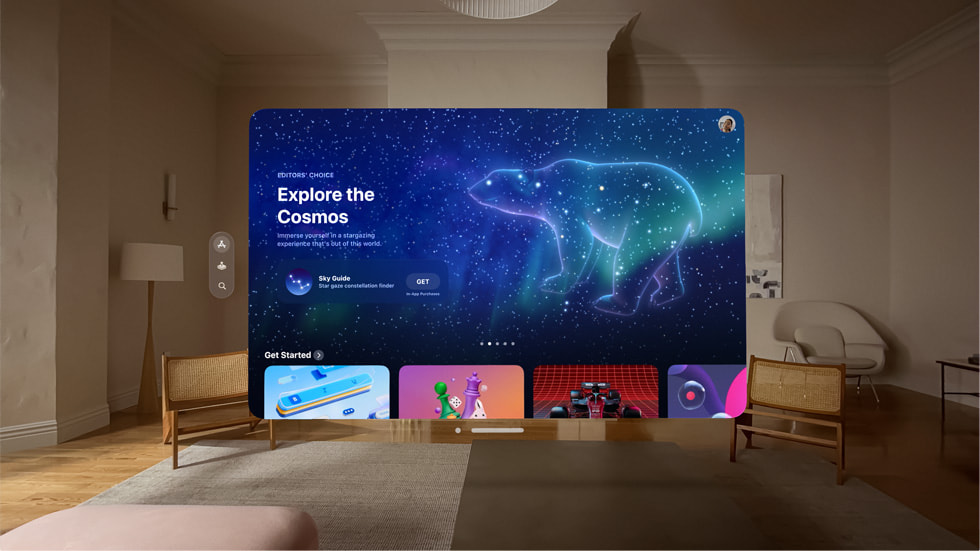
Vision Pro belongs to a category often described as spatial computing. Instead of placing games entirely inside a screen, the device allows digital elements to exist in the user’s physical space. Interfaces float in the air, respond to hand movements, and can be arranged around the user.
For word games, this changes the experience in subtle but important ways. Letters, tiles, or words can be placed at comfortable reading distances. Players can interact using natural gestures rather than controllers. Text can scale dynamically, reducing eye strain and improving readability, which is particularly relevant for longer play sessions.
Multiplayer interaction on Vision Pro can theoretically happen in several ways:
- Shared virtual spaces where multiple players see the same word board
- Pass-and-play or local multiplayer using one device
- Online multiplayer where players connect from different locations
Each of these approaches has different technical and social implications.
Current availability of multiplayer word games on Vision Pro
At present, the ecosystem of Vision Pro apps and games is still developing. Word-based experiences exist, but multiplayer word games specifically designed for spatial computing are limited in number.
Most word games available on Vision Pro today fall into one of these categories:
- Single-player word puzzles adapted from existing formats
- Word-based brain training exercises with no social component
- Experimental or small-scale multiplayer features, often asynchronous
In some cases, multiplayer functionality is inherited from existing platforms. For example, a word game originally designed for mobile devices may be adapted for Vision Pro, retaining online multiplayer through standard networking rather than spatial interaction. In these situations, Vision Pro serves more as a new display and input method than a fundamentally different multiplayer environment.
True shared spatial multiplayer, where multiple users see and interact with the same word elements in real time, is still rare. This is not due to a lack of interest, but rather the technical and design challenges involved in synchronizing text-based interaction across immersive spaces.
How multiplayer word games work in a spatial environment
When multiplayer word games do appear on Vision Pro, their design must account for comfort, clarity, and usability. Unlike fast-paced action games, word games benefit from calm pacing and clear visual hierarchy.
Common design patterns include:
- Floating word boards positioned at eye level
- Turn-based mechanics to avoid cognitive overload
- Clear visual indicators showing whose turn it is
- Subtle spatial separation between player areas to reduce confusion
Voice interaction can also play a role. Players may dictate letters or words, or discuss strategies verbally while interacting with the game board. This can enhance the social dimension, especially for cooperative modes.
Importantly, spatial multiplayer does not necessarily mean physically standing or moving around. Most word games are designed for seated or relaxed play, aligning well with Vision Pro’s emphasis on comfort and sustained use.
Practical use cases for multiplayer word games on Vision Pro
Even with limited availability, there are clear scenarios where multiplayer word games on Vision Pro make sense.
One use case is remote social play. Friends or family members in different locations can share a word-based activity that feels more personal than a phone app. Seeing words placed in a shared space can create a sense of presence without the intensity of fully embodied avatars.
Another use case is cooperative cognitive training. Multiplayer word puzzles can encourage discussion, memory recall, and problem-solving in a low-pressure environment. This is appealing to adults who want mental stimulation without reflex-based gameplay.
Educational contexts are also relevant. Language learners can practice vocabulary collaboratively, while teachers or facilitators guide word-based exercises in a shared virtual setting.
Benefits of multiplayer word games on Vision Pro
When well designed, multiplayer word games on Vision Pro offer several advantages over traditional platforms.
They can improve readability and reduce distractions by placing text in a controlled spatial layout. The absence of physical controllers makes interaction feel more natural, especially for users unfamiliar with gaming hardware.
Socially, spatial presentation can make multiplayer feel more engaging without becoming overwhelming. Players remain focused on language rather than fast reactions, which supports inclusivity across age groups.
From a cognitive standpoint, combining spatial awareness with language tasks may help reinforce memory and attention. While this should not be overstated, many users find spatial layouts easier to navigate than crowded flat screens.
Limitations and realistic expectations
Despite their potential, multiplayer word games on Vision Pro also face clear limitations.
The current app ecosystem is relatively small, and most developers prioritize genres that showcase immersive visuals rather than text-heavy gameplay. Multiplayer networking in spatial environments requires careful synchronization, which can be complex for smaller studios.
Another consideration is accessibility. Vision Pro is a premium device, which limits the size of the multiplayer user base. This affects matchmaking and long-term engagement for online word games.
Finally, not all word game mechanics benefit equally from spatial presentation. Simple turn-based games may feel similar to their tablet counterparts, with the main difference being display style rather than gameplay depth.
How Vision Pro fits into the broader future of word games
Looking beyond current availability, Vision Pro represents an interesting direction rather than a replacement for existing platforms. Word games have always adapted to new formats, from newspapers to smartphones. Spatial computing adds another option, particularly for social and collaborative experiences.
The long-term relevance lies less in novelty and more in comfort and presence. If spatial word games can offer relaxed, readable, and socially meaningful play, they may become a natural complement to mobile and desktop word games rather than a competitor.
For players interested in multiplayer word games specifically, Vision Pro is best seen as an emerging space. It offers new interaction possibilities, but it does not yet redefine the genre.
A calm look at what is possible today
So, are there multiplayer word games on Vision Pro? The answer is yes, but with important qualifications. Multiplayer features exist, often adapted from traditional platforms, while fully spatial, shared word game experiences are still uncommon. What Vision Pro does offer is a different way to engage with language-based play, emphasizing clarity, comfort, and presence over speed or spectacle.
For readers curious about the intersection of word games and spatial computing, Vision Pro is worth understanding as part of a broader evolution. It shows how even quiet, text-focused games can find a place in new technological environments, without losing their core appeal.
